GRAND CANYON, ARIZONA
Grand Canyon Rapids: A Whitewater Guide
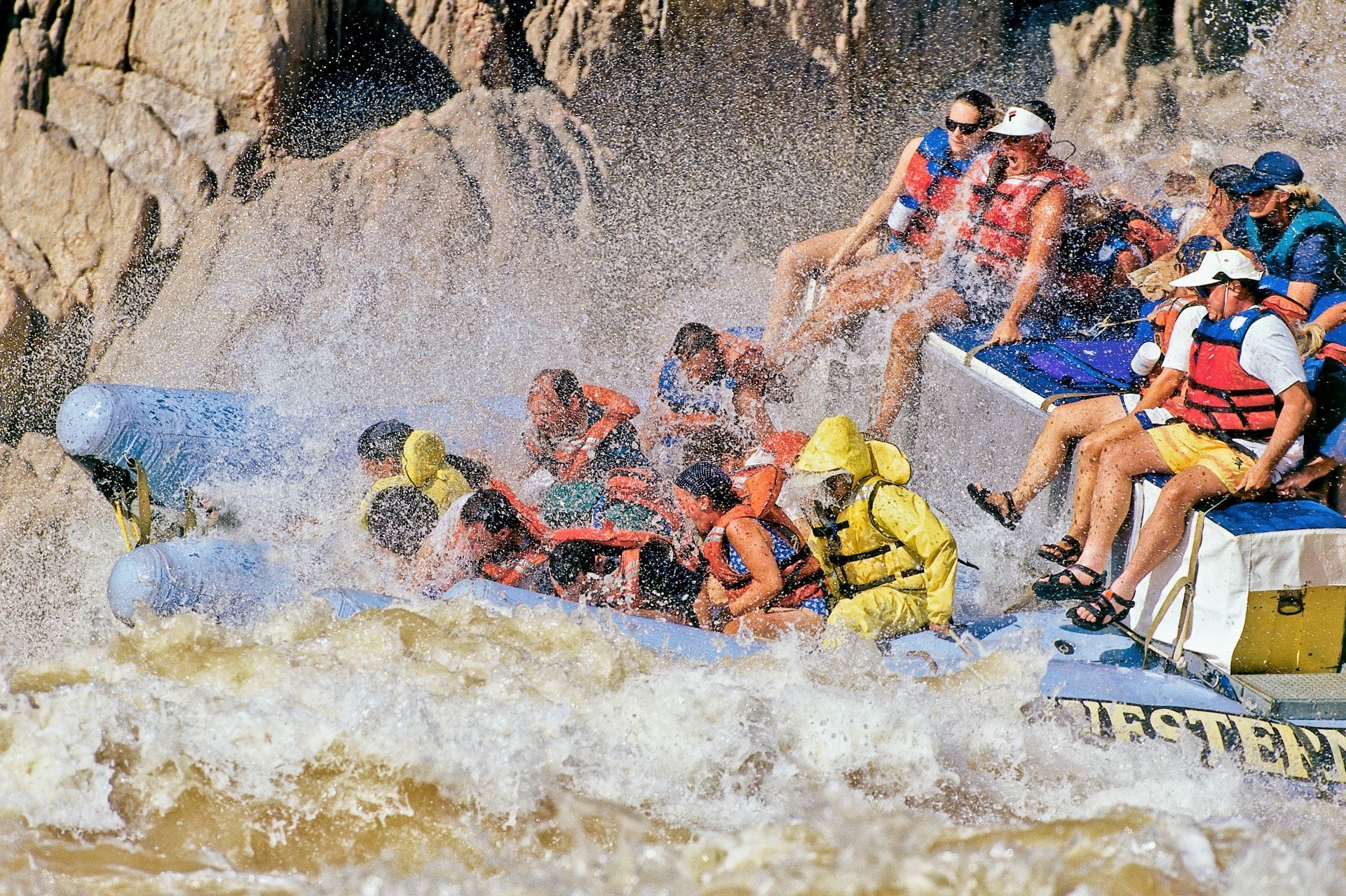
The rapids of the Grand Canyon are more than just whitewater. They’re the heartbeat of the river itself. For nearly 300 miles of river, calm stretches give way to powerful waves, towering hydraulics, and legendary rapid names like Hance, Hermit, Crystal, and Lava Falls. Each rapid brings a surge of excitement, teamwork, laughter, and awe, balanced by quiet moments beneath canyon walls carved over millions of years. The
Colorado River through the
Grand Canyon is one of nature's perfectly paced adventures where anticipation builds around every bend and each rapid becomes part of the story you’ll tell for the rest of your life.
The Grand Canyon's Own Rating System
Most rivers in the United States use the International Scale of River Difficulty: Class I (easy, flat water) through Class V (very difficult, expert-only) and up to Class VI (unrunnable or extremely hazardous). If you've done any river rafting before, you know that system.
The Grand Canyon uses its own whitewater rating system. It's a dedicated level 1-to-10 scale developed by river historian Otis R. Marston in the early days of organized canyon expeditions, before the International Scale ever existed. Years later, the broader 1-to-10 whitewater rating for Grand Canyon has stuck, as it provides a finer gradation of difficulty for over 160 rapids spread throughout 277 miles of river. Many of these rapids have big waves, powerful hydraulics, and conditions that shift significantly depending on the water level released from Glen Canyon Dam upstream.
Grand Canyon Rating System vs. International Scale
| GRAND CANYON RATING | STANDARD CLASS | WHAT IT MEANS |
|---|---|---|
| RATING 1-3 | Class I-II | Gentle ripples, easy waves |
| RATING 4-5 | Class II-III | Moderate waves, straightforward navigation |
| RATING 6-7 | Class III-IV | Significant waves, requires skilled guiding |
| RATING 8-9 | Class IV-V | Large hydraulics, technical, powerful |
| RATING 10 | Class V+ | Only a few that get this designation - each one earns it! |
How Many Rapids Are There in Grand Canyon?
~160 Rapids
Approximately 160 named rapids exist between Lees Ferry and Pearce Ferry, roughly 277 river miles.
42 Rated 5+
Roughly 42 rapids rated 5 or higher on the Grand Canyon's 1-to-10 scale.
95%+ Calm Water
The majority of the river is calm water through some of the most remote and visually spectacular scenery in the world.
How does the whitewater differ on each trip option?
Grand Canyon 6-Day and
Grand Canyon 7-Day
trips launch at Lees Ferry and run the upper two-thirds of the canyon, including every major named rapid above. Approximately 60 rapids total. These high-adventure trips include
Lava Falls and conclude with a helicopter ride out.
Minimum age: 12.
Grand Canyon 3-Day
and
Grand Canyon 4-Day River & Ranch trips helicopter into the lower canyon at the Whitmore Wash Helipad (mile 188) and run 92 miles downstream to Pearce Ferry, near Lake Mead. The lower canyon has 16 rapids in the Class II-III+ range, genuine whitewater with a more relaxed character than the upper section. These trips are a great introduction to Grand Canyon river travel for families with younger children, with a
minimum age of 9.
The Major Grand Canyon Rapids
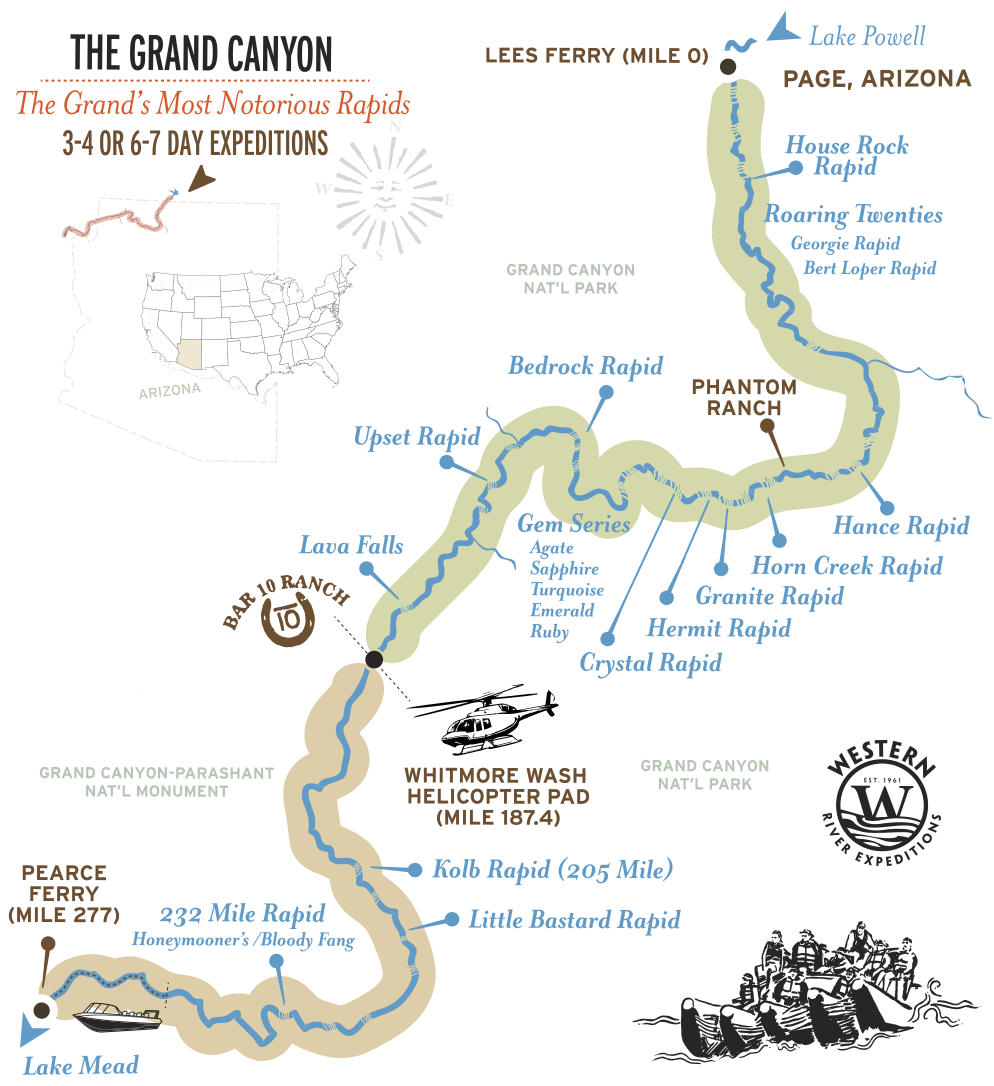
Some Grand Canyon rapids have reputations... some for their size or difficulty of navigation, and others for the stories behind their names. House Rock, Horn Creek, Granite, Crystal, and Lava Falls each have their own personality and history, and many more we don't even mention here! For guests, these rapids become defining moments, equal parts adrenaline, anticipation, and unforgettable canyon lore.
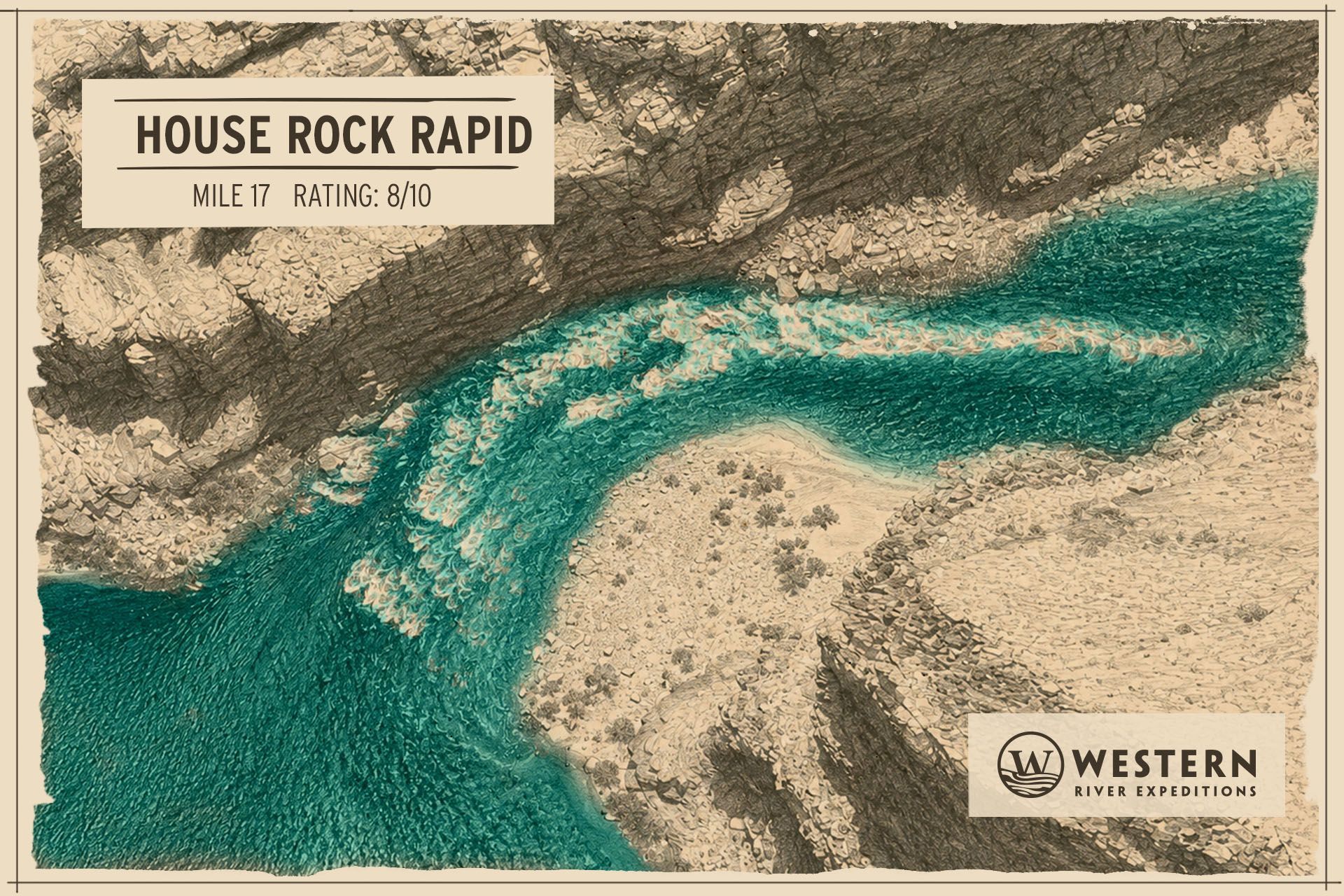
House Rock Rapid
MILE 17
RATING: 7-8
House Rock is the first major rapid below Lees Ferry, introducing guests to the Colorado’s powerful lateral waves, fast currents, and the beginning of true Grand Canyon whitewater.
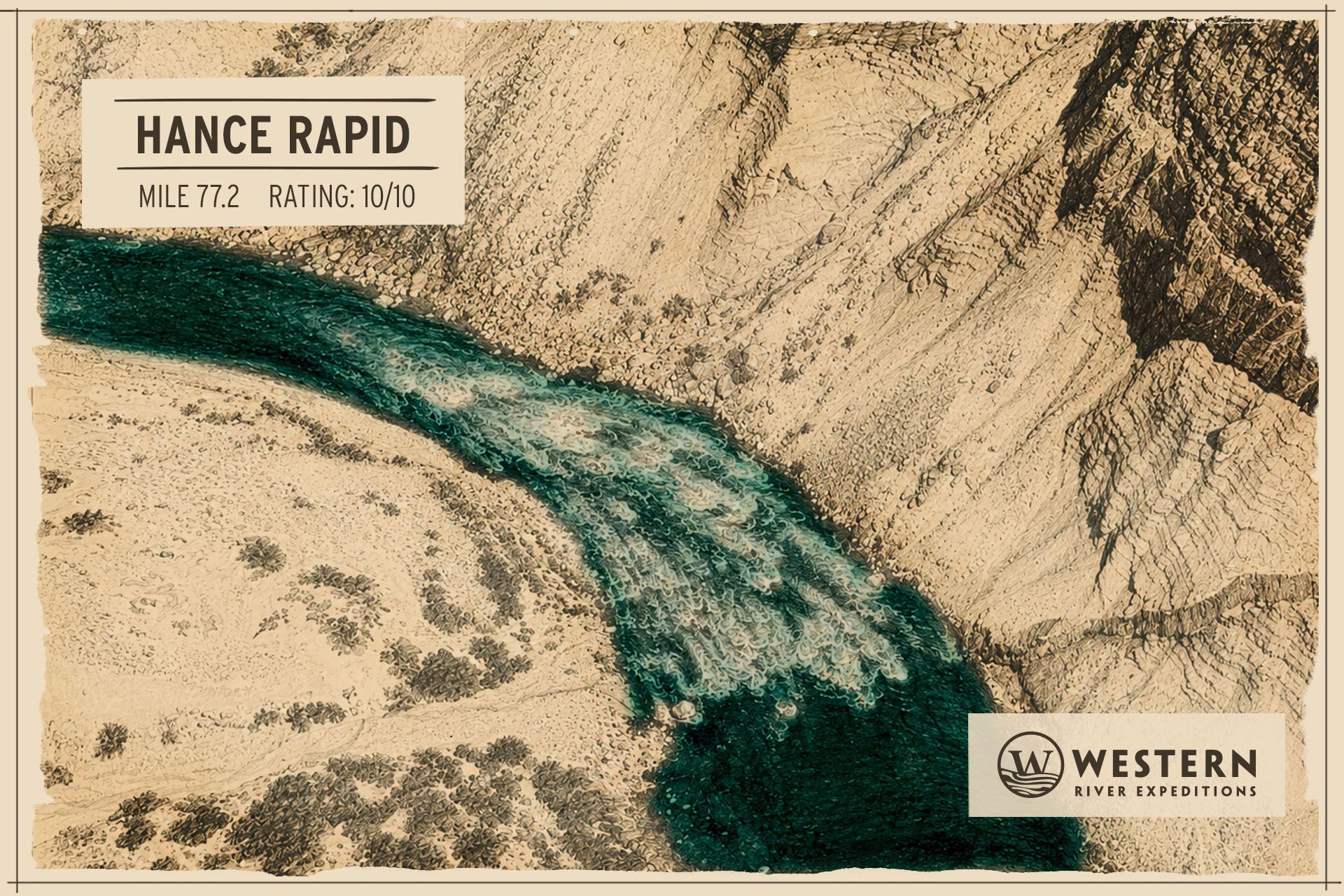
Hance Rapid
MILE 76.5
RATING: 8
Hance is the first major rapid of the upper canyon, where the Colorado turns serious. Massive boulders choke the channel, forcing guides to thread a precise line before funneling into the canyon's "inner gorge".
See the full rapid profile for Hance rapid
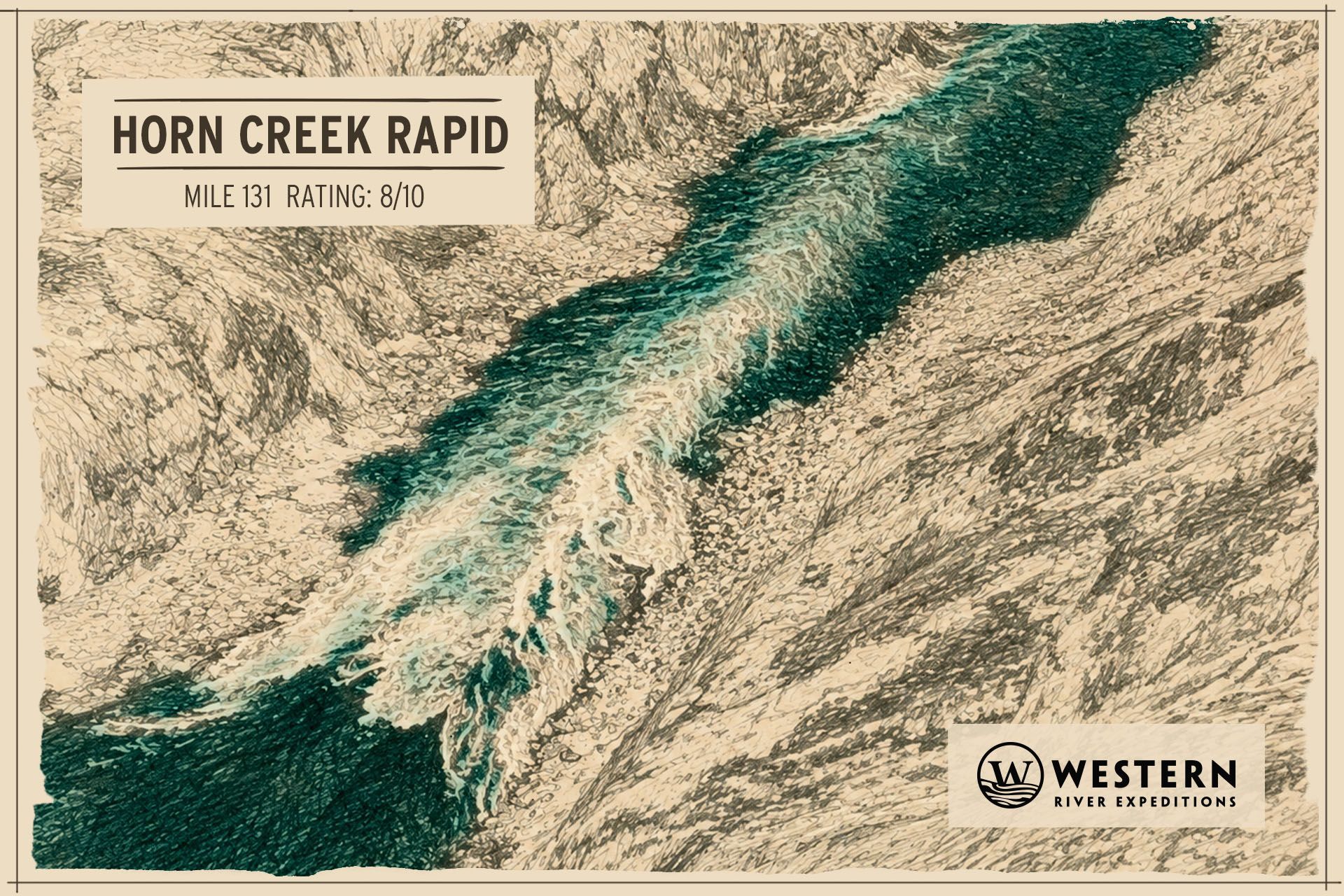
Horn Creek Rapid
MILE 90.8
RATING: 7-10
Horn Creek is short, fast, and deceptively powerful. Named for the horn-shaped hydraulics at its entrance, the rapid funnels through a narrow boulder field before exploding into loud, crashing whitewater that hits hard and fast.
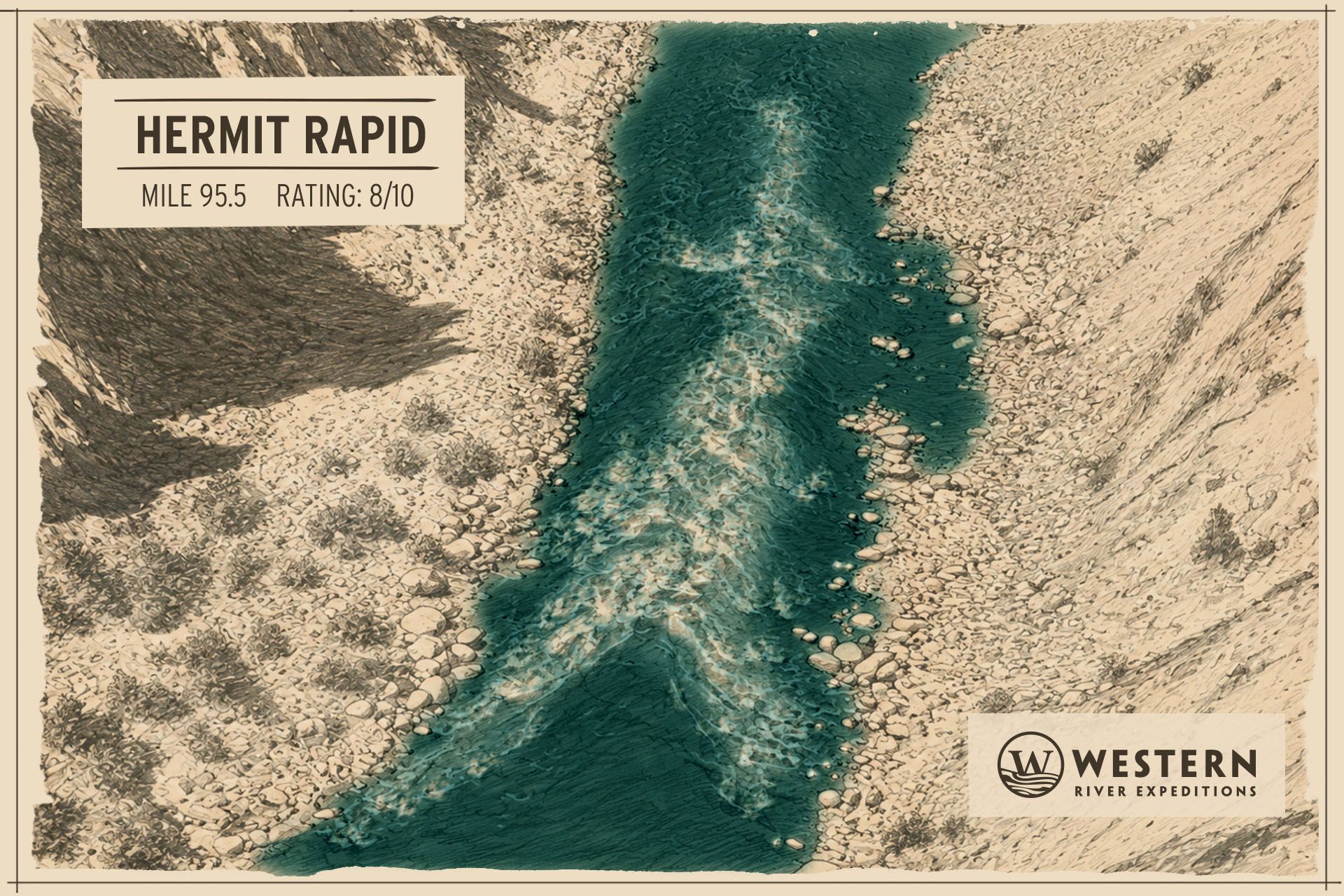
Hermit Rapid
MILE 95.5
RATING: 8-10
Hermit Rapid delivers the biggest wave train in the Grand Canyon towering standing waves that lift, drop, and surge with nonstop momentum. If Lava Falls is famous for power, Hermit is legendary for the ride itself.
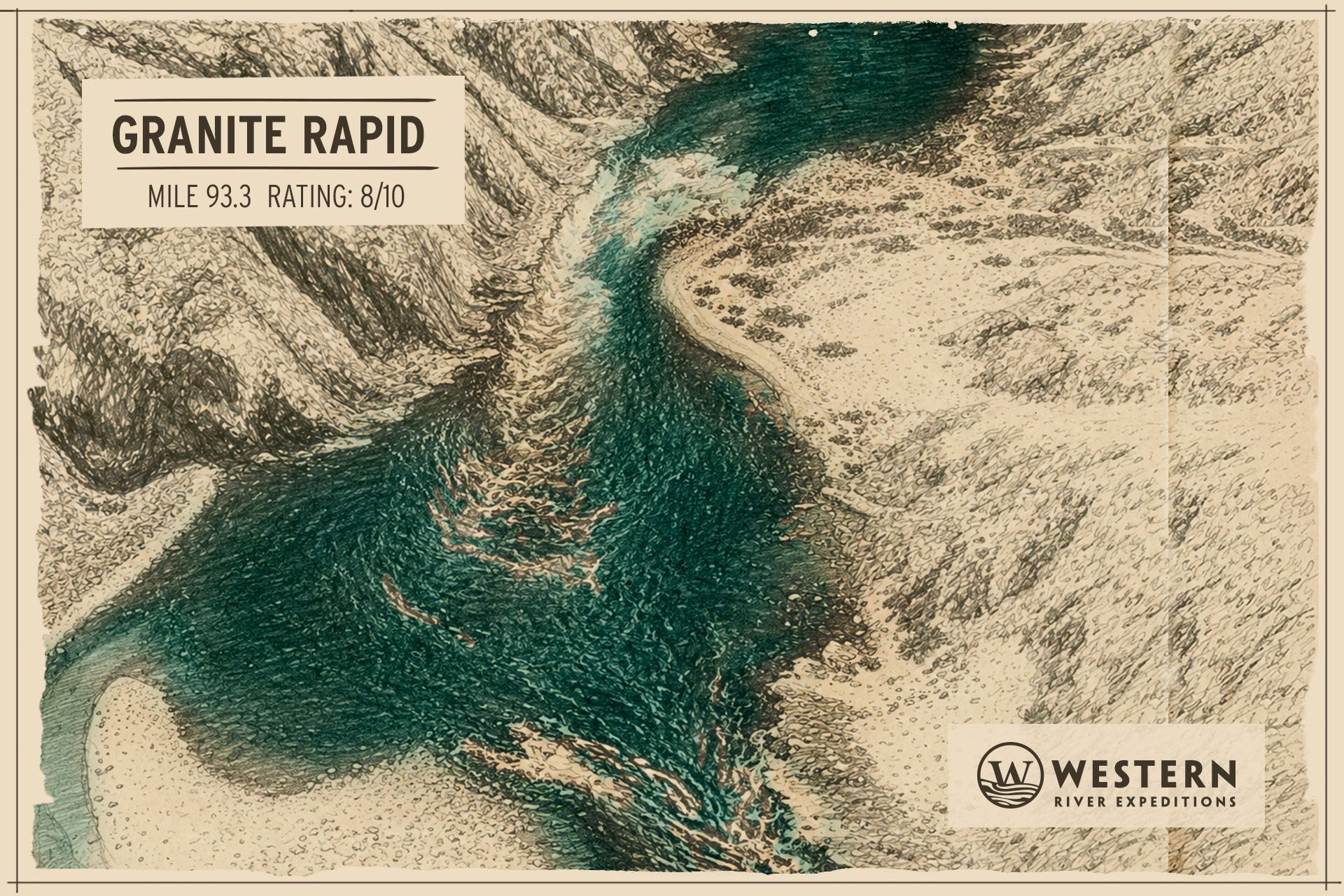
Granite Rapid
MILE 93.9
RATING: 8
Granite Rapid is one of the canyon’s most technical guide reads. The river drives hard toward the right wall below the main drop, demanding precise angles and perfect timing. Guests often feel only the thrill, not the complexity beneath them.
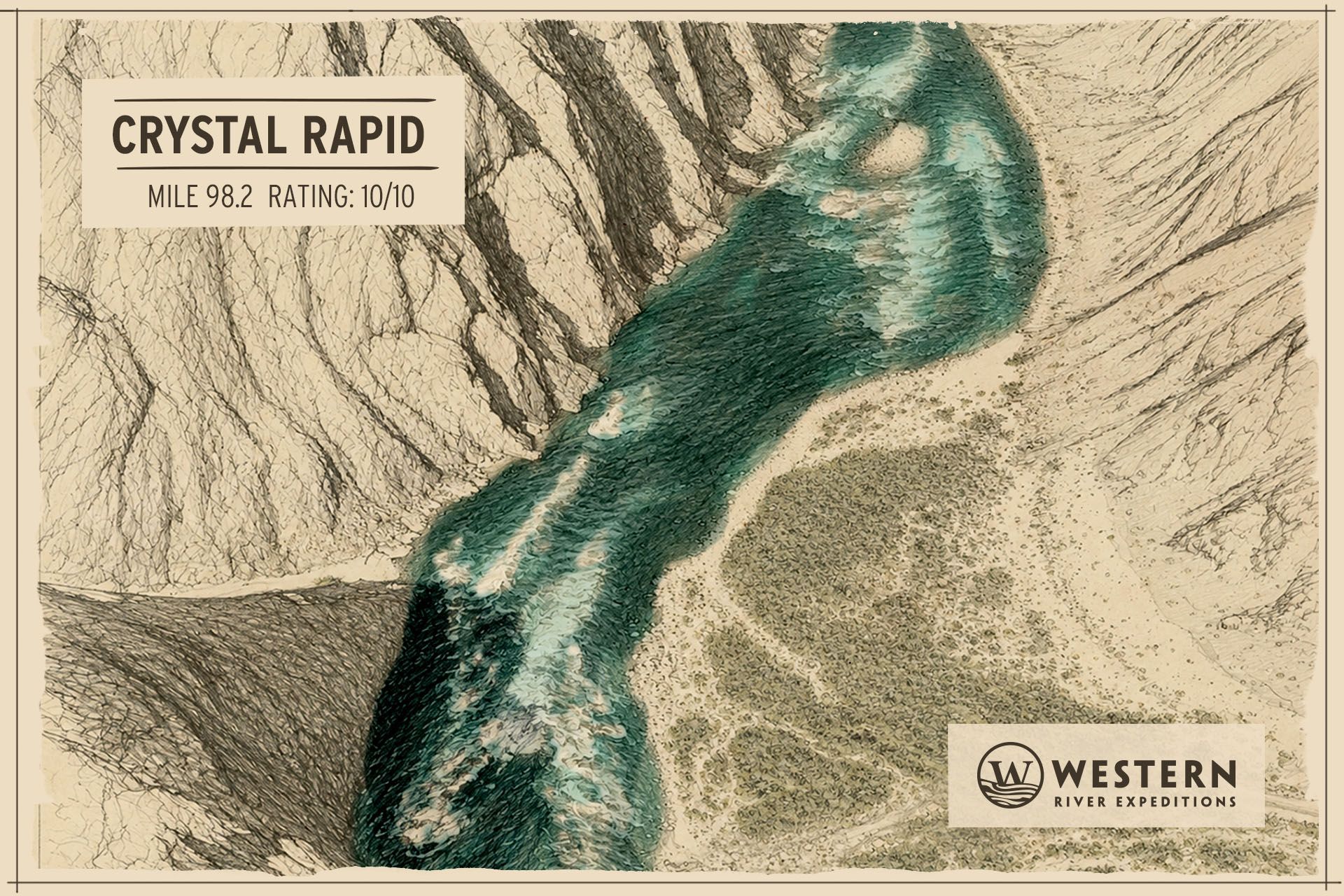
Crystal Rapid
MILE 98.2
RATING: 7-10
Crystal Rapid is one of the canyon’s most technical rapids, constantly changing with water levels and shifting currents. Born from a 1966 flash flood, it demands precision through huge waves, boulders, and tight maneuvering.
See the full rapid profile for Crystal Rapid
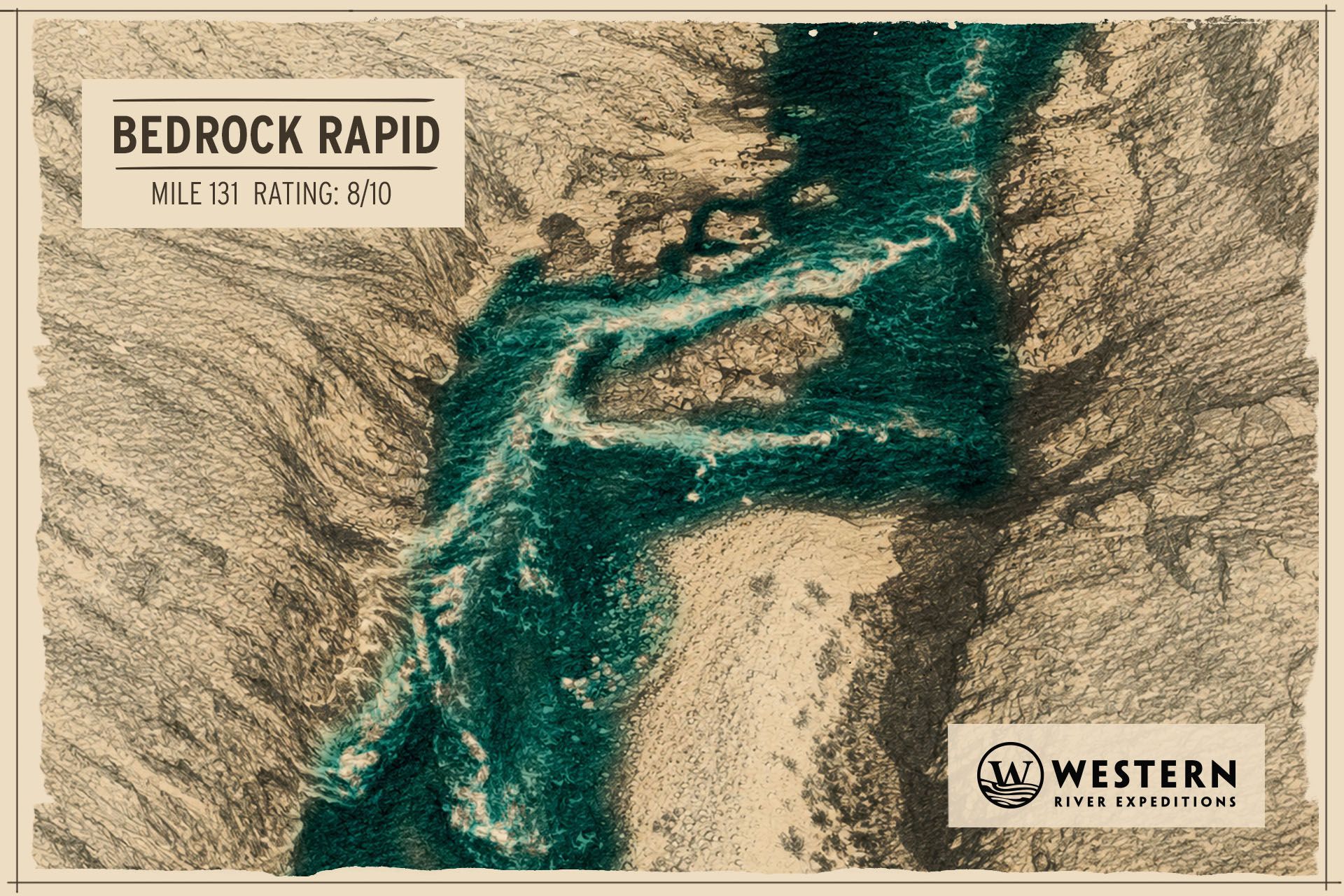
Bedrock Rapid
MILE 131.1
RATING: 6-8
Bedrock Rapid splits around a massive granite boulder that forces guides into a precise move against the strongest current. Tight maneuvering, shallow rocks, and powerful hydraulics make it one of the canyon’s most technical rapids.
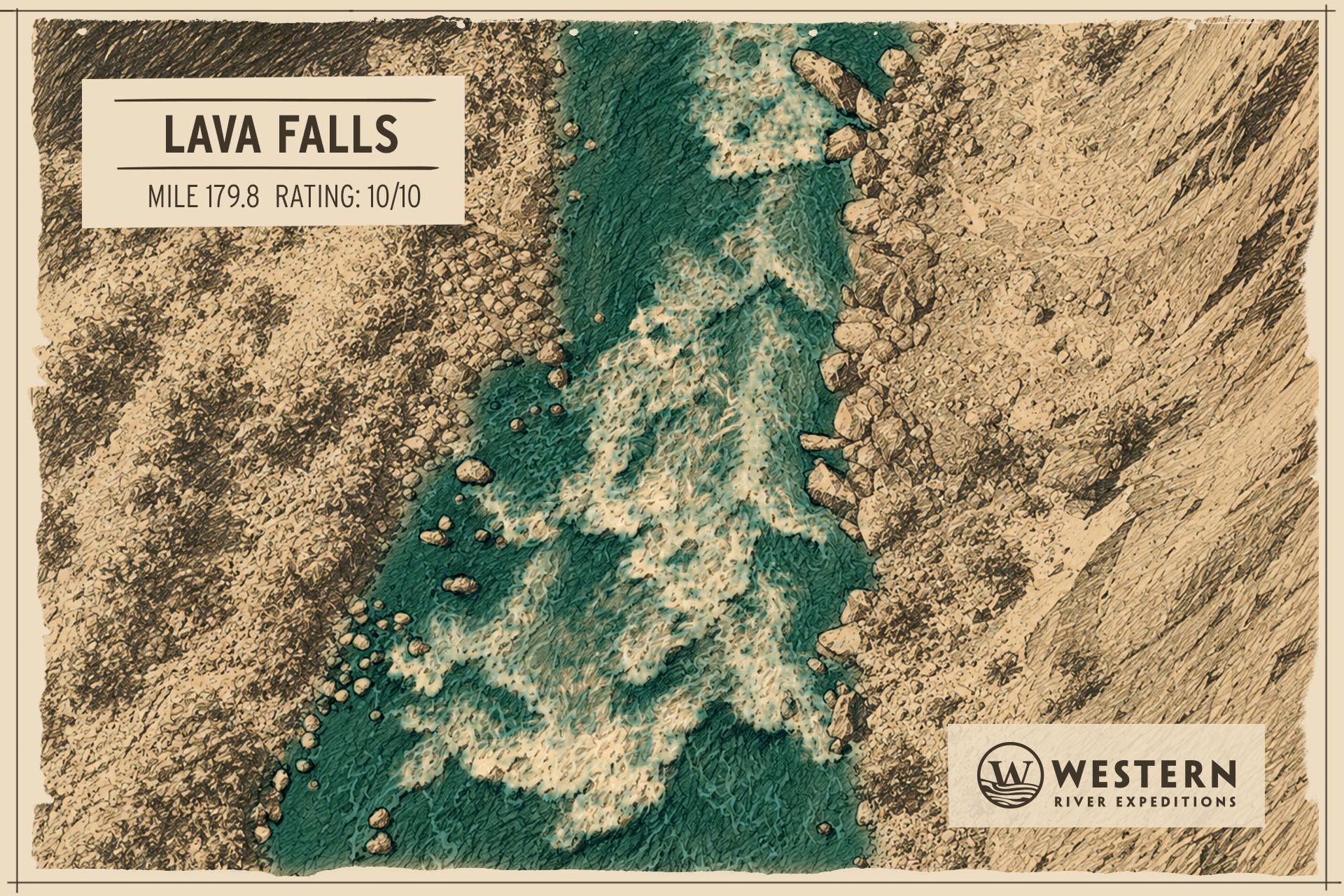
Lava Falls
MILE 179.8
RATING: 9-10
Lava Falls is the Grand Canyon’s most legendary rapid. Basalt walls tighten, the horizon disappears, and the Colorado explodes through massive waves and powerful hydraulics near the trip’s unforgettable finale.
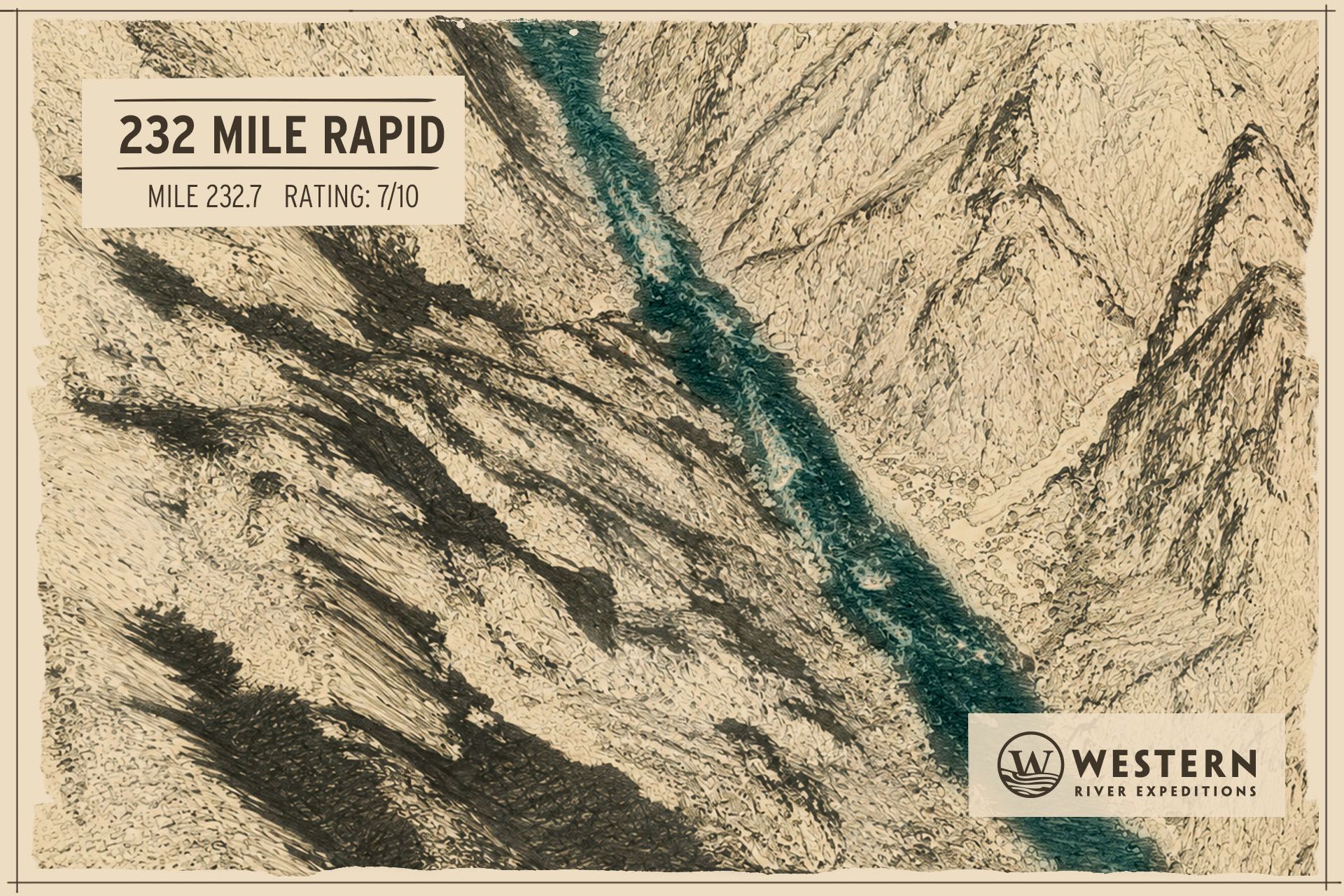
Honeymooner's (232 Mile)
MILE 232
RATING: 6-7
Honeymooner’s Rapid may sound gentle, but its name carries one of the canyon’s enduring mysteries. The rapid references Glen and Bessie Hyde, newlyweds who mysteriously disappeared downstream in 1928.
Experience Grand Canyon Rapids on Western River's J-Rig
Western's exclusive J-Rig raft will take you through every rapid on your Grand Canyon rafting trip. It was built with the guest experience in mind. The split-frame catamaran configuration of flexible pontoons cannot be found anywhere else.
J-Rigs literally "flex" over the waves as they rise to the crest and leap back down into the next trough, and back up again. It's a five-tube rollercoaster ride like nothing else! We are sold on its advantages, but you can see for yourself. Book the trip and feel it first-hand - with front and back handholds, of course!
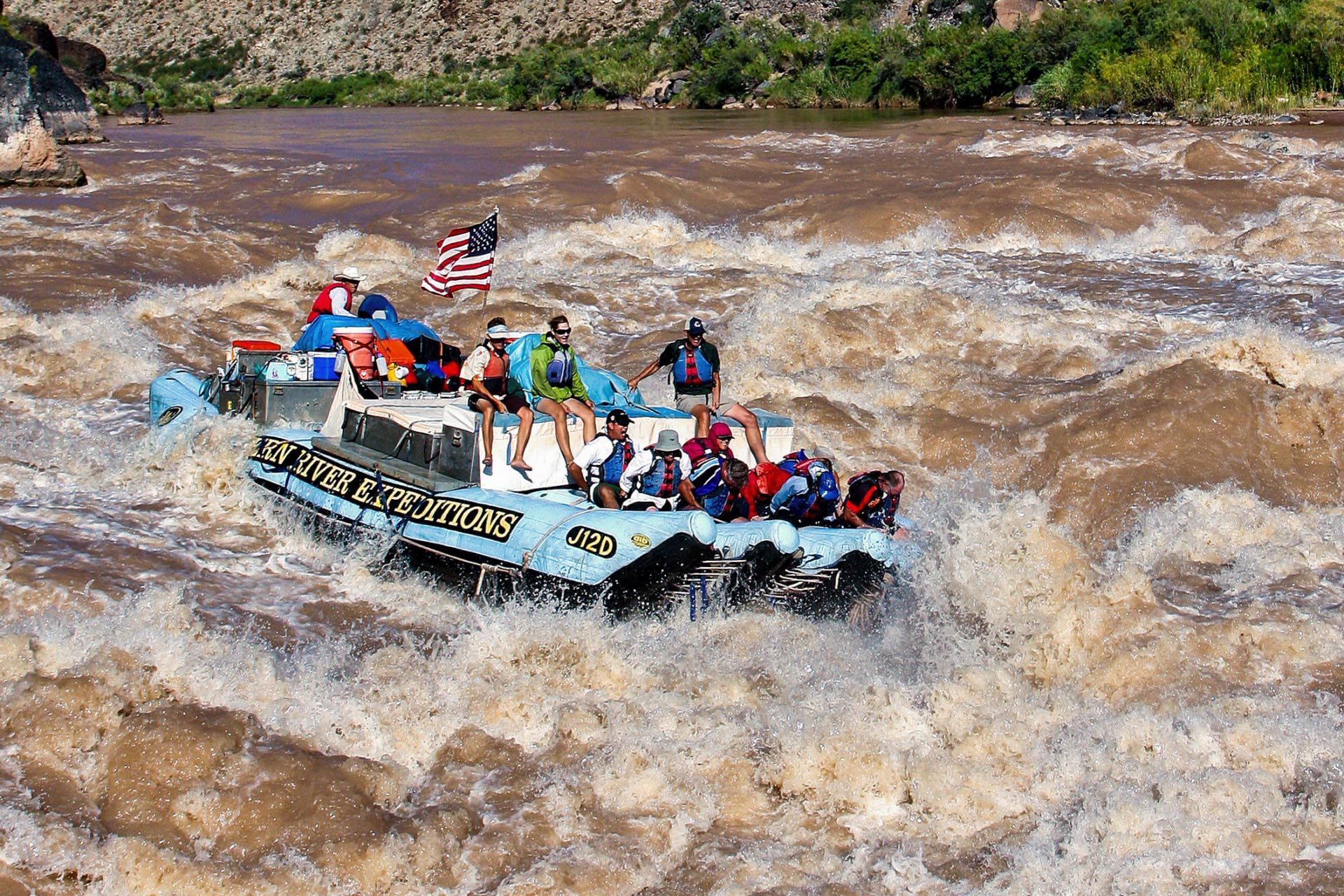
Where you sit changes the ride.
The J-Rig accommodates up to 18 guests on single-boat trips and 14 per raft on 2-boat trips. It has multiple seating positions along its length, and each one delivers a different experience of the same rapid.
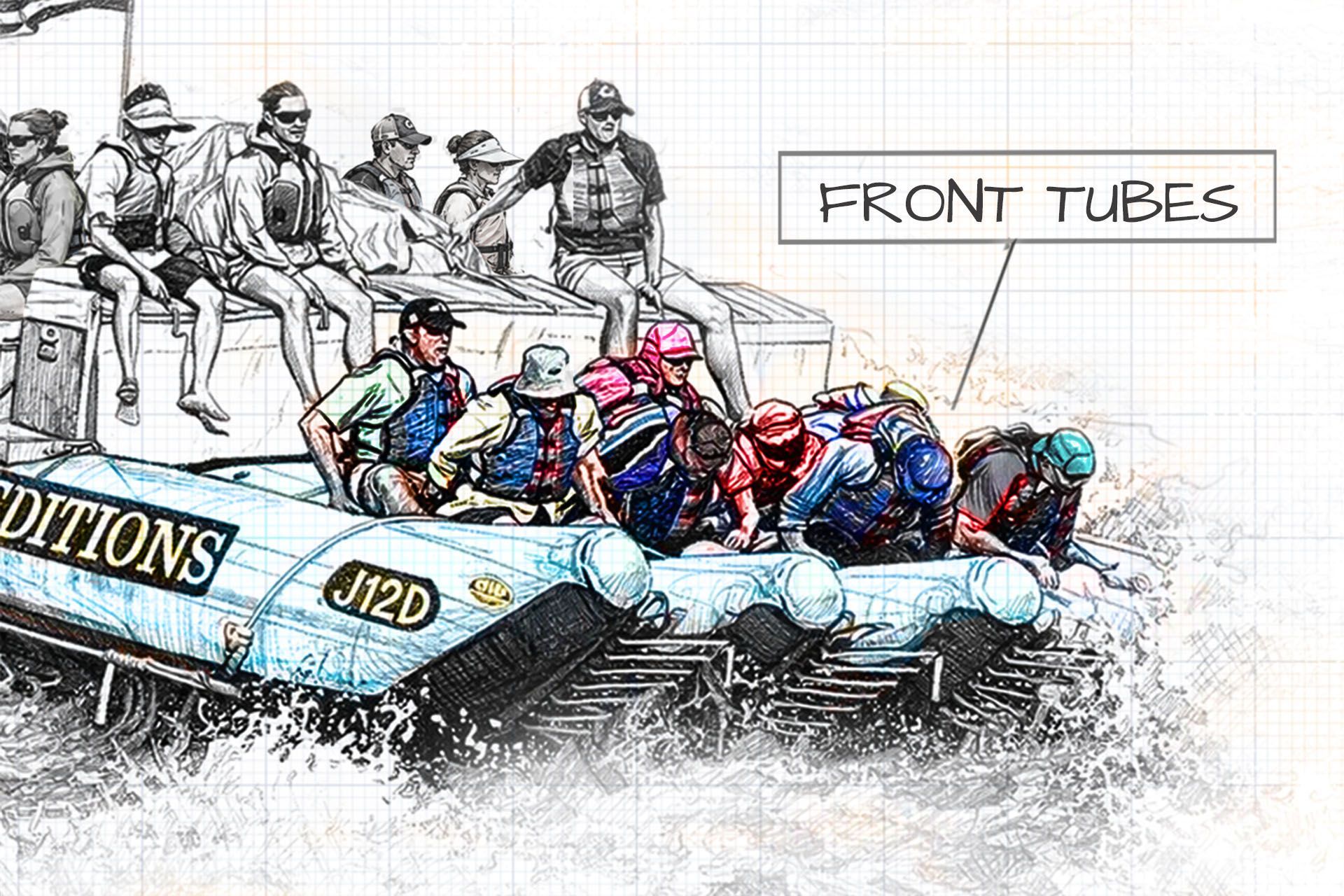
The Front "Bull rider" Tubes
The front tubes of the J-Rig offer the biggest thrill. On the biggest waves, guests put their heads down and feel the full force of the wave go over them.
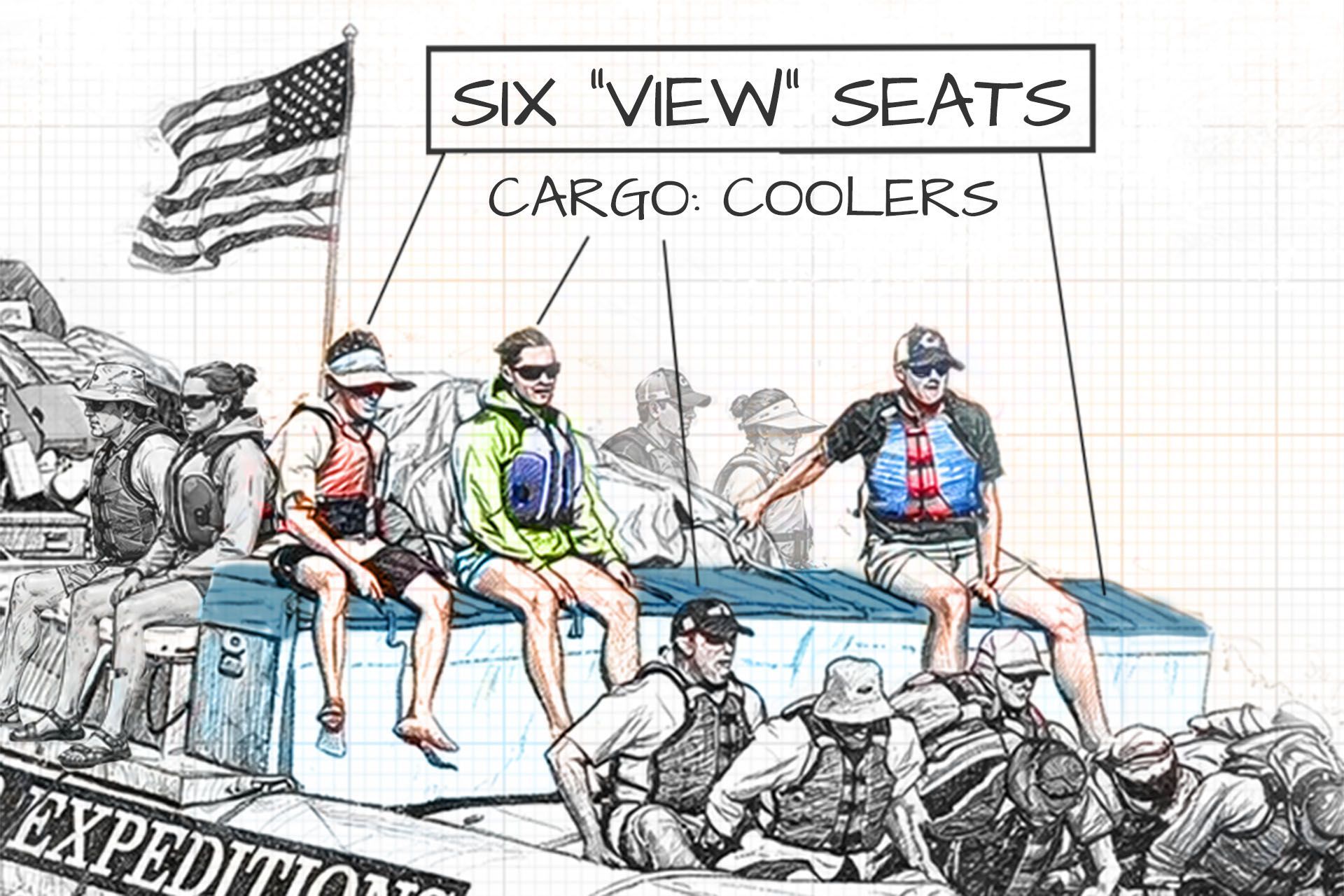
The "buckin' cooler" Bench seats
The view seats atop the coolers provide an exciting ride, an excellent vantage point of the whitewater ahead, and a great view of those riding the front tubes.
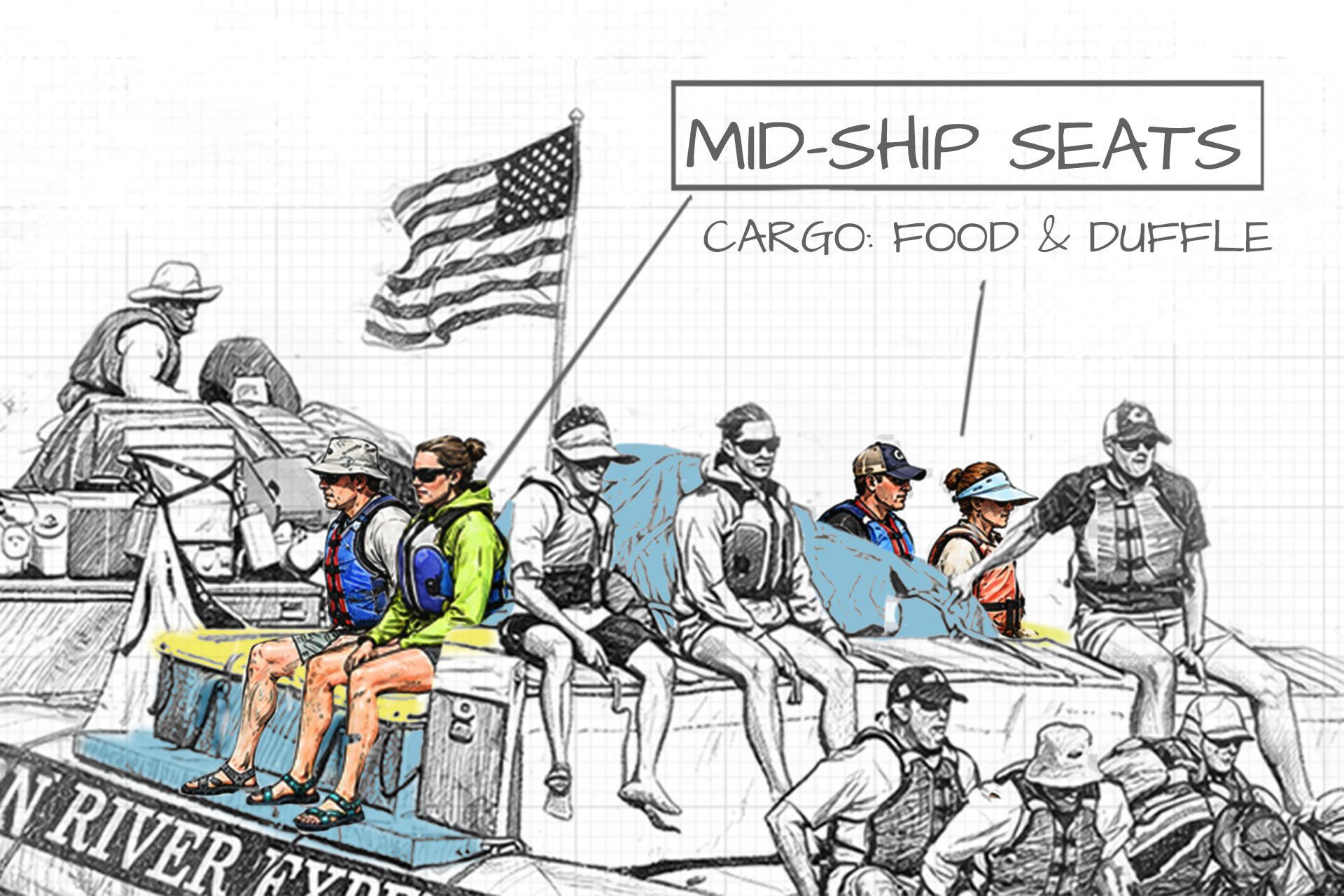
THE MID-SHIP "protected ride" SEATS
Perfect for those seeking a calmer seat, the J-Rig's midship seats are also ideal for relaxing, taking in the canyon views, and staying a little drier in the rapids.
You choose where to sit, and you can change positions between rapids. Ride the front through Hermit and the padded "mid-ship" seats through
Crystal Rapid. Stay up front for the whole trip! Move around with your group as the day changes. The flexibility means a single J-Rig can carry guests who want every drop at full intensity and guests who'd rather watch the canyon drift by, on the same boat, same rapid. No other Grand Canyon raft offers this kind of choice. No wonder Western's J-Rig got the nickname "The Cadillac of the Colorado."
What Happens at Each Rapid
Every rapid has its own unique configuration, but they all share certain traits. To a river guide these are simply navigational signs to read your way down the river.
The Tongue of the Rapid
After a few rapids, you'll begin to notice a smooth laminar flow "tongue" in the shape of a "V" that leads into the turbulence of the whitewater froth. This points the way, until some other obstacle gets in the way!
The Wavetrain
A wave train is a rolling series of standing waves that sends the raft climbing, cresting, and dropping again and again through the rapid. Unlike a sudden vertical drop, wave trains build rhythm and momentum, giving guests the sensation of riding the river itself. One moment you’re rising above the whitewater, the next you’re buried in the trough before surging upward again through exploding whitewater and spray.
Domers and Holes
“Domers” and “holes” are two of the river’s most nearly hidden features. A domer forms when water piles upward into a smooth, rounded mound on the upstream side of a boulder or obstacle. A hole is formed on the downstream side of these boulders. A hole forms when water folds back on itself, on the downstream side of the boulder. Holes can stop, surf, or spin smaller boats. Guides scan or "read" the currents constantly, using angles, momentum, and experience to work with the river’s power instead of against it to avoid obstacles as best as possible.
The Run
Often you'll hear a guide say, "that's the run" when describing the planned route through a rapid. They may also refer to this as "Plan A" because it's what they plan to make happen in the frothing, crashing, super-fun world of river rafting.
The Eddy
Eddies are pockets of calmer water that form along the river's edge. Created by the force of the current rushing past obstacles, they circulate upstream while the main flow continues downstream. Guides use these natural pullouts to pull over for camps, lunch stops, hikes, and scouting rapids. They're incredibly useful when you enter them on purpose.
What Guests Say About the Rapids
"By Lava Falls, I was leaning into it."
★★★★★
I was terrified of the rapids before we left. My husband kept reassuring me, but I had real anxiety about it. Then we hit the first one and I was, laughing? The guide had briefed us so thoroughly that nothing felt out of control. By the time we got to Lava Falls, I was leaning into it.
Susan M. - TripAdvisor
"Best 30 seconds of the trip."
★★★★★
Hermit Rapid was the one I didn't expect. Everyone talks about Lava Falls, and yes, Lava Falls is something else. But Hermit's wave train? The size of those waves? I had no idea. We were soaked and screaming and the guide was grinning. Best 30 seconds of the trip.
Todd R. - Google
"That was the best thing I have ever done."
★★★★★
I can't swim. I want to be honest about that. I was genuinely scared about getting on this trip. And then we went and hit Crystal and Hermit and Lava Falls and I came home thinking, that was the best thing I have ever done. The J-Rig is enormous and the guides are extraordinary and I never felt unsafe. Not once.
Pam L. - TripAdvisor

★★★★★
360+ REVIEWS

★★★★★
800+ REVIEWS

★★★★★
1K+ REVIEWS

★★★★★
80+ REVIEWS
Adventure with confidence
Frequently Asked Questions
How many rapids are in the Grand Canyon?
There are roughly 160 named rapids along the full Grand Canyon river corridor from Lees Ferry to Pearce Ferry, Lake Mead. On the Grand Canyon’s 1-to-10 rating scale, many rapids are gentle riffles or moderate drops, while the larger rated rapids require skilled guiding. Western’s 6-Day or 7-Day trip from Lees Ferry to Whitmore Wash is where most of the larger rapids are found. The lower canyon's 3-4 day trips enjoy smaller rapids throughout the adventure.
What rating system does the Grand Canyon use?
The Grand Canyon uses its own 1-to-10 scale developed specifically for the Colorado River, not the standard Class I-V system used on most whitewater rivers. A "10" on the Grand Canyon scale is equivalent to Class V+ on the standard scale. The rating shifts with water level: rapids that run as a 7 at low flows can jump to 9 or 10 when Glen Canyon Dam releases more water. Guides assess current conditions and line choice before every rapid.
What is the hardest rapid in the Grand Canyon?
Lava Falls, at mile 179.8, is rated 9-10 and is considered the hardest navigable rapid on the Colorado River through the Grand Canyon. Crystal Rapid (mile 98.2) rivals it at high water, earning a 10 rating when flows rise. Both are on the 6-Day and 7-Day trip itineraries. Hance, Bedrock and others still rank "up there" for guides!
Are the rapids intimidating for first-time rafters?
First-timers make up a large share of every trip. Western River runs exclusive J-Rig motorized rafts, 14-18 person rafts that handle Grand Canyon's biggest water with a stability no paddle raft or oar boat can match. The versatile seating options of the J-Rig make the rapids of the Grand Canyon "first-timer friendly
What is the biggest wave in the Grand Canyon?
Hermit Rapid (mile 95.5, rating 7-10) produces the largest consistent standing wave train in the Grand Canyon, a sequence of eight to ten consecutive waves that can reach 10-15 feet at peak flows. Lava Falls has the same potential on the wave that cycles and crests as it billows off of the "Big Bertha Rock". Hermit is often guests' most physical and memorable rapid, despite being overshadowed by Lava Falls in pre-trip conversation.
Is the 3-Day trip a good trip if I want whitewater?
The 3-Day and 4-Day trips launch into the lower canyon at Whitmore Wash (mile 188) and run 89 miles of the Colorado River to Lake Mead, including 16 rapids in the Class II-III+ range. The lower canyon's rapids are smaller than the upper canyon's famous drops, but they're genuine whitewater, appropriate for families with children as young as 9, and a legitimate Grand Canyon river experience.
Does water level affect how difficult the rapids are?
The ride and guest experience aren't necessarily affected overall as some rapids get larger waves in lower water and vice-versa. Glen Canyon Dam releases between 8,000 and 14,000+ cubic feet per second depending on the season and electricity demand, and rapid difficulty tracks directly with those releases. Crystal Rapid is the most sensitive, transforming from technically manageable at low water to one of the canyon's most notorious features at high water. Western River guides check flow forecasts before every trip and adapt their lines and briefings accordingly.
Will I get wet?
Yes, you will get wet. The J-Rig is an open boat. On major rapids, especially Hermit, Crystal, and Lava Falls, cold water hits from above, below, and both sides. On more minor rapids, those sitting farther back may stay mostly dry. Either way, between rapids, guests dry out quickly in the dry desert air. A rain jacket and pants can make rapids more comfortable during the earlier morning hours or cooler temperatures.
Where should I sit on the J-Rig if I'm nervous about the rapids?
If you're nervous about the rapids, sit in the middle of the boat. The J-Rig has multiple seating positions along its length, and the midship seats give you the most measured ride: still in the rapid, sometimes wet, but with far less direct impact than the front. The "cooler" view seats are a step up in intensity, and the front tubes deliver the biggest hits. You can choose your seat at the start of the day and change between rapids. Most first-timers ride the back early in the trip and move forward as their confidence builds.
Still curious to learn more?
See more common questions
or contact us.
Choose Your Grand Canyon Adventure
Six days in the Grand Canyon. Run Crystal Rapid and Lava Falls, hike hidden side canyons, sleep on beaches no road will ever reach, and helicopter out of the canyon.
- Begins: Las Vegas
- Best for: Rapids & Hiking
- Rapids: 60+ Class III-V
- Ages: 12+
Seven days exploring 188 miles of the Grand Canyon. Run famous rapids, hike hidden side canyons, camp beneath the stars, and helicopter out of the canyon.
- Begins: Las Vegas
- Best for: Extended Vacation
- Rapids: 60+ Class III-V
- Ages: 12+
Helicopter into the Lower Grand Canyon for three days of whitewater, hikes, and desert nights. Then continue downstream by jet boat to Pearce Ferry.
- Begins: Las Vegas
- Best for: Shorter trip
- Rapids: 16 Class II-III
- Ages: 9+
One night at Bar 10 Ranch with horseback riding and cowboy BBQ, then helicopter into the Lower Grand Canyon for three days of whitewater rafting and exploration.
- Begins: Las Vegas
- Best for: River + Ranch
- Rapids: 16 Class II-III
- Ages: 9+
All Grand Canyon trips conveniently depart from Las Vegas, Nevada.
Not sure which trip is right for you?
Compare all Grand Canyon trips or call us:
(801) 459-3525
Ready to experience Grand Canyon whitewater?
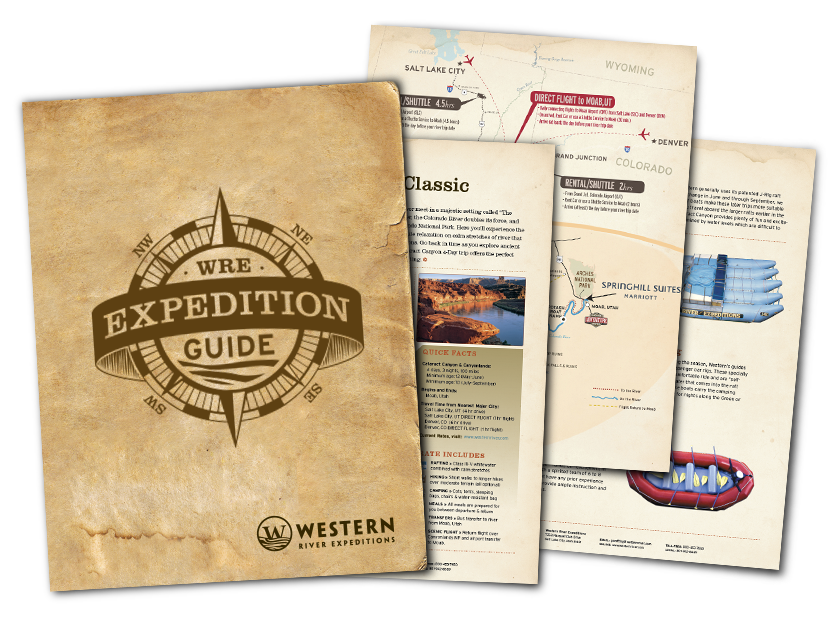
River maps, itineraries, camping details, weather, packing lists, travel logistics, and more, all in one place. Get a complimentary expedition guide for any trip that interests you.